LOUGHBOROUGH’S MUNITIONS ROLE
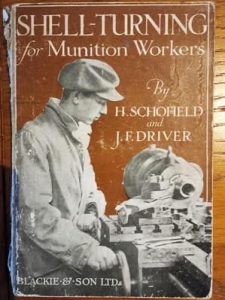
WW1 was above all an artillery war. To feed the guns, there was an insatiable need for shells and for the skilled workers who could make them. The Carillon has in the collection in its care a book “Shell Turning for Munition Workers”, co-written by Herbert Schofield, who had an important role in munitions production in Loughborough.
With many skilled men away at the front, injured or killed, the Ministry of Munitions decreed that a number of centres for the training of munitions workers should be set up. One was to be in Loughborough, in the Technical Institute in Ashby Road. Herbert Schofield, Principal of the Institute, was enthusiastic about the training idea and offered the Institute’s premises and workshops to the Ministry.
The Instructional Factory
It became known as the Instructional Factory. The first intake of trainees arrived in January 1916, and they were all female. The book shows a man on the cover, but throughout the war, up to a million women worked in the munitions factories, carrying out dirty, dangerous but essential work, often at the expense of their health and even their lives. The training they received at the Instructional Factory enabled them to take on more skilled tasks, working with lathes, grinders, gauges, milling machines, woodworking and welding, towards the production of shells and aircraft parts. Perhaps Schofield’s book played a part in the teaching.
Training completed, they were then deployed to munitions works around the country.
There were places at the factory for men too, including discharged injured servicemen. The idea was that it would equip them with skills for earning a living in the postwar world. Engineering firms could also send their workers to the factory to learn new skills. The courses lasted anything from a few weeks to several months, and after a trial period, the trainees were paid. Needless to say, the men got paid more.
Life at the Instructional Factory
The factory was run along real factory lines, replicating a typical engineering works. Trainees had to clock in and out, and work shifts during unsocial hours. The women were provided with overalls to cover their long dresses, and mob caps, whereas the men were expected to bring their own protective clothing. Contemporary photographs show little evidence of safety gear.
Nevertheless, the trainees’ welfare was a priority. Many were away from their home comforts and friends, and decent accommodation was needed. To begin with, they were billeted in private homes, then several properties in Loughborough were bought, to serve as hostels.
In the factory canteen trainees could choose a full dinner for 1 shilling, or soup and pudding for 6d. The club room was furnished with comfortable chairs, a billiards table and a piano, open every evening until 10pm. There was a rest room for use during working hours and a fully equipped first aid facility. Trainees were also encouraged to organise their own entertainments.
Over 1,300 men and women passed through Loughborough’s Instructional Factory during the course of the war. For the men, it would have given them useful jobs skills for supporting their families after the war. How many of the women, though, considered a postwar career in engineering? If they had, it was unlikely that opportunities would be available.
For more information New… – Loughborough Carillon Tower & War Memorial Museum | Facebook