VJ Day: remembering some Loughborough POWs
15th August 1945 was Victory over Japan Day, the very end of World War ll. Like VE Day a few months earlier, it was joyfully celebrated by the Allies, albeit in the horrific shadows of Hiroshima and Nagasaki.
This blog looks at the men on the Carillon WW2 Roll of Honour who lost their lives as prisoners of war of the Japanese, in the appalling conditions well documented by survivors and remembered in countless movies and dramas.
There are detailed records of prisoners held in the Japanese camps, allowing us to follow the journeys of the unfortunate men who populated them. Most were taken prisoner at the fall of Singapore on 15th February 1942.
These are the men who had Loughborough connections.
Corporal 4860087 Leonard Raymond Hilsdon of the 1st Leicesters, was an upholsterer who worked at Lowe & Sons in Church Gate; the shop is still in business. His name appears on a list of ‘parties transferred overland 1942’. As he died in a POW camp in Thailand the following year, it’s likely that he was sent to work on the notorious Thailand-Burma railway. Whether he died as a result of starvation, disease or brutal treatment, we cannot know, but it was likely to have been a combination of all three. He was 24.
Gunner 4859575 Clifford William Rees of the Royal Artillery was born in Wales but moved to Loughborough with his family. He died in a Japanese POW camp, aged 23.
Sapper 1873978 William Henry Soars was born in Loughborough and worked at the Brush. In 1942, serving in the Royal Engineers, he was taken prisoner and sent to Chunkai camp, where he survived the ordeal of working on the Thailand to Burma railway for just under two years. He died aged 28, of ‘polyavitaminosis’ – i.e a lack of several vitamins. In the POW camps, the men were fed mainly on small amounts of white rice. Beri-beri, caused by a lack of vitamin B1, was one result of these starvation rations.
There were other frequent causes of death. Private 4859947 Cyril Herbert Walton, born in Willoughby-on-the-Wolds but living in Loughborough, and serving in the Leicestershire Regiment, died of acute enteritis in September 1943 after 18 months as a Japanese POW. He was 25.
Sergeant T/108246 Ernest Dowell Gee Bosomworth, born in Loughborough and also an employee at the Brush, ended up in No 2 Camp, Sonkurai, Thailand, working on the Thailand-Burma railway. Ernest didn’t last long there, dying just three months later, of colitis. He was not quite 25. Colitis, which would have covered any kind of gastro-intestinal disorder, killed very many of the prisoners, and could have been caused by bad food, dirty water, or parasites.
Malaria killed many. One was Gunner 1828365 Cyril Redman. He was born in Loughborough, and married with a young son when he was taken prisoner. He died in January 1945, aged 34, at a place called Sandakan. At this camp, one punishment was being locked into a cage about the size of a dog kennel for up to 30 days. The prisoners were set to work building an airfield, but in January 1945 work on this was stopped after bombing by allied forces. The same month, a group of about 455 prisoners were sent on forced marches away from the camp, which became known as the Sandakan Death Marches. It’s possible that Cyril Redman was amongst them. The Japanese camp commanders were tried for war crimes and hanged or shot in 1946.
Malaria, cholera, infected wounds, malnutrition or simple exhaustion, were major causes of death but not the only ones. Private 4856230 Alfred Mons Billings of the 1st Leicesters was killed on 7th September 1944 when the area close to No 1 Thailand Camp was bombed by the Allies. Alfred died of wounds from bomb splinters. He was 29. A memoir written by a survivor of the raid says: “After the fires died down the camp was in darkness and it was not until some hours after the raid that the full extent of the destruction and loss of life became apparent. Around a hundred men had been killed and many more had sustained horrific injuries. This incident caused a great deal of resentment among the men who could not believe that the Allied Command were unaware that a POW camp was located next to their targets.”
Gunner 2063179 Cecil Hemslie Harding, of the Royal Artillery, born in Loughborough, died aged 23 during one of the most shameful episodes in the Far East theatre. After his capture he sent his parents a reassuring (and no doubt censored) postcard saying “Our camp is well equipped and the accommodation is comfortable. Our daily life is pleasant.” He was eventually held in a camp on Ambon Island in Indonesia. In November 1943, the Japanese decided to ship the sick prisoners in Ambon back to Java. 640 men, Cecil Harding amongst them, were loaded onto the Suez Maru, one of the many ‘hell ships’ used by the Japanese for transporting prisoners. The passengers also included about 200 sick and wounded Japanese soldiers. However, it was not marked as a prisoner or hospital ship, as required by the Geneva Convention. The vessel was torpedoed by an American submarine and sank. Some prisoners managed to escape and swim away, others perished, trapped in the holds. The Japanese survivors were picked up by a Japanese minesweeper. But its captain gave orders to fire on the Allied survivors in the water. Lifeboats and rafts holding prisoners from the Suez Mara were rammed and sunk. When all the prisoners had been massacred, the minesweeper sped away. This atrocity was investigated as a war crime in 1949. The ship’s commanders were arrested but never sent for trial and were released. To this day, descendants of the murdered men are still seeking justice. Cecil Harding’s POW record simply says he died ‘at sea’.
The final name of the Loughborough POWs is Corporal 1889118 Jeffrey Hallam of the Royal Engineers. Like many others, he was set to work on the death railway but survived and returned home in October 1945. The following year he married Margaret Fickling and the couple set up home in Loughborough. Jeff died, aged 29, less than two years later, after an operation at Loughborough Hospital. As the newspaper report on Jeff’s funeral noted ‘the privations which he suffered [as a POW] were largely responsible for the failure of his health‘.
We are currently updating our online WW2 Roll of Honour. If you have any details of a family member or friend listed on it we would be very pleased to hear from you.
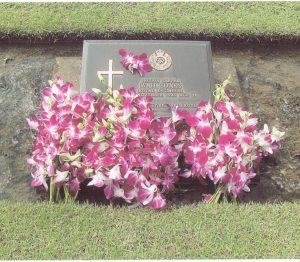
A Carillon volunteer (now deceased) on a trip to Thailand, visited the camp where William Soars was imprisoned. He laid flowers on his grave.
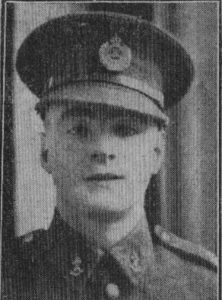 William Henry Soars 1915-1943