MUSIC FROM LOUGHBOROUGH
The opening of the refurbished Carillon War Memorial Museum is a reminder that, as well as being a memorial to Loughborough’s war dead, the Carillon is also a unique musical instrument, whose sound has been delighting the town for over 100 years.
This blog looks at some of the occasions marked by the melodious sounds produced by those 47 bells.
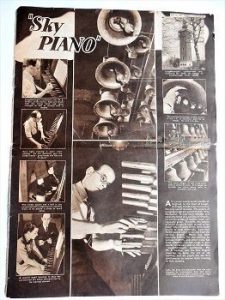
The first Borough Carillonneur to be appointed was Eric Jordan, who took up his post when the Carillon opened in the summer of 1923, and held it for more than 50 years, eventually tutoring his successor, Peter Shepherd. The current Borough Carillonneur is Caroline Sharpe, who is also a soprano singer and choir director.
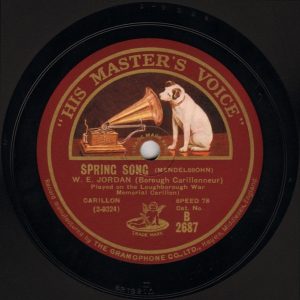
Almost from the beginning, Carillon recitals not only rang out across Loughborough but were regularly broadcast by the BBC. A record of its music was also sold on the HMV label. (Double sided, price 3 shillings). However, a year after the tower opened, a town councillor patronisingly said that the townsfolk would prefer simpler tunes at the recitals, adding, seemingly without any irony, that the music was ‘much above their heads’.
The writer of a letter to the Leicester Evening Mail in 1926 related how on a peaceful Sunday evening in Loughborough he was ‘enchanted by the beauty of the recital’ and wondered why some enterprising bus company had not started organising Sunday night visits to the Carillon.
This was the sort of thing much disapproved of by the British Legion, who voiced concerns that the Carillon’s original purpose as a war memorial had been trivialised, and it had become ‘a novelty of the town’. With the iconic building now appearing on adverts for bacon, they probably had a point.
The British Legion also wouldn’t have approved of the Carillon being ‘on the talkies’. In 1930 a short sound film was made of the tower, with Eric Jordan filmed at the clavier (or keyboard).
More seriously, in June 1939 it was reported that an exchange of recitals between the Carillon and Malines in Belgium was heard as far away as Poland. With the threat of Nazi invasion looming over that country, it must have been a poignant reminder of the existence of a freer world, where the beauty of music was valued. And in 1940, the playing of the Dutch national anthem in Queen’s Park was a source of delight to some Dutch refugees in the audience.
Throughout the 1950s a regular programme of recitals took place, with Carillon Festivals in the 1960s. And at Christmas 1958, Associated Rediffusion recorded Eric Jordan playing ‘Good King Wenceslas’ for use during TV commercial breaks. After 25 takes, he not surprisingly said ‘I never want to hear that tune again’.
Today, the bells of Loughborough’s Carillon continue to ring out over the urban bustle of the town centre, with regular performances all year. You can also buy a CD of Caroline Sharpe’s carillon playing.